Question (1)
Find $\left| {\overrightarrow a \times \overrightarrow b } \right|$, if $\overrightarrow a = \widehat i - 7\widehat j + \widehat k$ and $\overrightarrow b = 3\widehat i - 2\widehat j + 2\widehat k$Solution
$\overrightarrow a = \widehat i - 7\widehat j + \widehat k$, $\overrightarrow b = 3\widehat i - 2\widehat j + 2\widehat k$\[\overrightarrow a \times \overrightarrow b = \left| {\begin{array}{*{20}{c}}{\widehat i}&{\widehat i}&{\widehat k}\\1&{ - 7}&7\\3&{ - 2}&2\end{array}} \right|\] \[\overrightarrow a \times \overrightarrow b = \left( { - 14 + 14} \right)\widehat i - \left( {2 - 21} \right)\widehat j + \left( { - 2 + 21} \right)\widehat k\] \[\overrightarrow a \times \overrightarrow b = 19\widehat j + 19\widehat k\] \[\left| {\overrightarrow a \times \overrightarrow b } \right| = \sqrt {{{\left( {19} \right)}^2} + {{\left( {19} \right)}^2}} \] \[\left| {\overrightarrow a \times \overrightarrow b } \right| = \sqrt {2{{\left( {19} \right)}^2}} = 19\sqrt 2 \]
Question (2)
Find a unit vector perpendicular to each of the vector $\overrightarrow a + \overrightarrow b $ and $\overrightarrow a - \overrightarrow b $, where $\overrightarrow a = 3\widehat i + 2\widehat j + 2\widehat k$ and $\overrightarrow b = \widehat i + 2\widehat j - 2\widehat k$Solution
$\overrightarrow a = 3\widehat i + 2\widehat j + 2\widehat k$ , $\overrightarrow b = \widehat i + 2\widehat j - 2\widehat k$$\overrightarrow a + \overrightarrow b = 3\widehat i + 2\widehat j + 2\widehat k + \widehat i + 2\widehat k - 2\widehat k$
$\overrightarrow a + \overrightarrow b = 4\widehat i + 4\widehat j$
$\overrightarrow a - \overrightarrow b = 3\widehat i + 2\widehat j + 2\widehat k - \widehat i - 2\widehat j + 2\widehat k$
$\overrightarrow a - \overrightarrow b = 2\widehat i + 4\widehat k$
Let $\overrightarrow c $ be perpendicular to $\overrightarrow a + \overrightarrow b $ and $\overrightarrow a - \overrightarrow b $
$\therefore \overrightarrow c = \left( {\overrightarrow a + \overrightarrow b } \right) \times \left( {\overrightarrow a - \overrightarrow b } \right)$
$\overrightarrow c = \left| {\begin{array}{*{20}{c}}{\widehat i}&{\widehat j}&{\widehat k}\\4&4&0\\2&0&4\end{array}} \right|$
$\overrightarrow c = 16\widehat i - 16\widehat j - 8\widehat k$
$\left| {\overrightarrow c } \right| = \sqrt {{{16}^2} + {{16}^2} + {{\left( { - 8} \right)}^2}} $
$\left| {\overrightarrow c } \right| = \sqrt {256 + 256 + 64}$
$\left| {\overrightarrow c } \right| = \sqrt {576} $
$\left| {\overrightarrow c } \right| = \pm 24$
$ \text{unit vector of} \quad \overrightarrow c = \frac{{\overrightarrow c }}{{\left| {\overrightarrow c } \right|}}$
$\overrightarrow c = \frac{{16\widehat i - 16\widehat j - 8\widehat k}}{{ \pm 24}}$
$\overrightarrow c = \pm \frac{2}{3}\widehat i \mp \frac{2}{3}\widehat j \mp \frac{1}{3}\widehat k$
Question (3)
If a unit vector $\overrightarrow a $ makes angle $\frac{\pi }{3}$ with $\widehat j$ and an acute angle θ with $\widehat k$, then finf θ and hnece, the components of $\overrightarrow a $Solution
The angle made by vector with x, y and z axis be α, β and γ$\alpha = \frac{\pi }{3}$, $\beta = \frac{\pi }{4}$ $\gamma = \theta $
$\overrightarrow a = \left( {\cos \alpha ,\cos \beta ,\cos \gamma } \right)$ is cosine direction of vector
$ \therefore {\cos ^2}\alpha + {\cos ^2}\beta + {\cos ^2}\gamma = 1$
${\cos ^2}\frac{\pi }{3} + {\cos ^2}\frac{\pi }{4} + {\cos ^2}\theta = 1$ ${\left( {\frac{1}{2}} \right)^2} + {\left( {\frac{1}{{\sqrt 2 }}} \right)^2} + {\cos ^2}\theta = 1$
${\cos ^2}\theta = 1 - \frac{1}{4} - \frac{1}{2}$
${\cos ^2}\theta = \frac{1}{4}$
$\cos \theta = \frac{1}{2}$
$\theta = {\cos ^{ - 1}}\left( {\frac{1}{2}} \right)$
$\theta = \frac{\pi }{3}$
$ \text{component of} \overrightarrow a = \left( {\frac{1}{2},\frac{1}{{\sqrt 2 }},\frac{1}{2}} \right)$
Question (4)
Show that $\left( {\overrightarrow a - \overrightarrow b } \right) \times \left( {\overrightarrow a + \overrightarrow b } \right) = 2\left( {\overrightarrow a \times \overrightarrow b } \right)$Solution
$LHS = \left( {\overrightarrow a - \overrightarrow b } \right) \times \left( {\overrightarrow a + \overrightarrow b } \right)$$ = \overrightarrow a \times \overrightarrow a + \overrightarrow a \times \overrightarrow b - \overrightarrow b \times \overrightarrow a - \overrightarrow b \times \overrightarrow b $
$\overrightarrow a \times \overrightarrow a = \overrightarrow 0 $
$ - \overrightarrow b \times \overrightarrow a = \overrightarrow a \times \overrightarrow b $
$LHS = \overrightarrow 0 + \overrightarrow a \times \overrightarrow b + \overrightarrow a \times \overrightarrow b - \overrightarrow 0 $$ - \overrightarrow b \times \overrightarrow a = \overrightarrow a \times \overrightarrow b $
$LHS = 2\left( {\overrightarrow a \times \overrightarrow b } \right) = RHS$
Question (5)
Find λ and µif $\left( {2\widehat i + 6\widehat j + 27\widehat k} \right) \times \left( {\widehat i + \lambda \widehat j + \mu \widehat k} \right) = \overrightarrow 0 $Solution
$\left( {2\widehat i + 6\widehat j + 27\widehat k} \right) \times \left( {\widehat i + \lambda \widehat j + \mu \widehat k} \right) = \overrightarrow 0 $$\left| {\begin{array}{*{20}{c}}{\widehat i}&{\widehat j}&{\widehat k}\\2&6&{27}\\1&\lambda &\mu \end{array}} \right| = \overrightarrow 0 $
$\left( {6\mu - 27\lambda } \right)\widehat i - \left( {2\mu - 27} \right)\widehat j + \left( {2\lambda - 6} \right)\widehat k = \overrightarrow 0 $
$ \Rightarrow 6\mu - 27\lambda = 0$
$2\mu - 27 = 0$
$ \Rightarrow \mu = \frac{{27}}{2}$
$2\lambda - 6 = 0$ $ \Rightarrow \lambda = 3$ $\mu = \frac{{27}}{2} and \lambda = 3 $
Question (6)
Given that $\overrightarrow a \cdot \overrightarrow b = 0$ and $\overrightarrow a \times \overrightarrow b = 0$. What can you conclude about the vectors $\overrightarrow a $ and $\overrightarrow b $?Solution
Giiven :$\overrightarrow a \cdot \overrightarrow b = 0$ and $\overrightarrow a \times \overrightarrow b = 0$ since $\overrightarrow a \cdot \overrightarrow b = 0$
$ \Rightarrow \left| {\overrightarrow a } \right| = \overrightarrow 0 $ or $\left| {\overrightarrow b } \right| = \overrightarrow 0 $ Or $\overrightarrow a \bot \overrightarrow b $
$\overrightarrow a \times \overrightarrow b = 0$
$ \Rightarrow \left| {\overrightarrow a } \right| = \overrightarrow 0 \quad or \quad \left| {\overrightarrow b } \right| = \overrightarrow 0 \quad or \quad \overrightarrow a ||\overrightarrow b $ The vectors are parallel and perpendicular to each other which is not possible
$ \therefore \left| {\overrightarrow a } \right| = \overrightarrow 0 \quad or \quad \left| {\overrightarrow b } \right| = \overrightarrow 0 \]
Question (7)
Let the vectors $\overrightarrow a $, $\overrightarrow b $, $\overrightarrow c $ be given as ${a_1}\widehat i + {a_2}\widehat j + {a_3}\widehat k$, ${b_1}\widehat i + {b_2}\widehat j + {b_3}\widehat k$, ${c_1}\widehat i + {c_2}\widehat j + {c_3}\widehat k$Then show that \[\overrightarrow a \times \left( {\overrightarrow b + \overrightarrow c } \right) = \overrightarrow a \times \overrightarrow b + \overrightarrow a \times \overrightarrow c \]
Solution
$\overrightarrow a = {a_1}\hat i + {a_2}\hat j + {a_3}\hat k$$\overrightarrow b = {b_1}\hat i + {b_2}\hat j + {b_3}\hat k$
$\overrightarrow c = {c_1}\hat i + {c_2}\hat j + {c_3}\hat k$
$\overrightarrow b + \overrightarrow c = \left( {{b_1} + {c_1}} \right)\widehat i + \left( {{b_2} + {c_2}} \right)\widehat j + \left( {{b_3} + {c_3}} \right)\widehat k$
$LHS = \overrightarrow a \times \left( {\overrightarrow b + \overrightarrow c } \right)$
$ = \left| {\begin{array}{*{20}{c}}{\widehat i}&{\widehat j}&{\widehat k}\\{{a_1}}&{{a_2}}&{{a_3}}\\{{b_1} + {c_1}}&{{b_2} + {c_2}}&{{b_3} + {c_3}}\end{array}} \right|$
By the property of determinants
$= \left| {\begin{array}{*{20}{c}}{\widehat i}&{\widehat j}&{\widehat k}\\{{a_1}}&{{a_2}}&{{a_3}}\\{{b_1}}&{{b_2}}&{{b_3}}\end{array}} \right| + \left| {\begin{array}{*{20}{c}}{\widehat i}&{\widehat j}&{\widehat k}\\{{a_1}}&{{a_2}}&{{a_3}}\\{{c_1}}&{{c_2}}&c\end{array}} \right|$
$LHS = \overrightarrow a \times \overrightarrow b + \overrightarrow a \times \overrightarrow c $
LHS = RHS
Question (8)
If either $\overrightarrow a = \overrightarrow 0 $ or $\overrightarrow b = \overrightarrow 0 $, then $\overrightarrow a \times \overrightarrow b = \overrightarrow 0 $. Is the converse true? Justify your answer with an example.Solution
$ \text {given} \quad \overrightarrow a = 0\,\,or\,\overrightarrow b = 0$Prove that $\overrightarrow a \times \,\overrightarrow b = 0$
$LHS = \overrightarrow a \times \overrightarrow b $ \[LHS = \left| {\overrightarrow a } \right|.\left| {\overrightarrow b } \right|\sin \theta \] $LHS = 0$ as either $ \overrightarrow a = 0\,\,or\,\overrightarrow b = 0$
Connerse statement is if $\overrightarrow a \times \overrightarrow b = \overrightarrow 0 $, then either $\overrightarrow a = 0$ or $\overrightarrow b = 0$. It is not true.
$\overrightarrow a \times \overrightarrow b = \left| {\overrightarrow a } \right|\left| {\overrightarrow b } \right|\sin \theta = \overrightarrow 0 $
So if two non zero vectors are parallel then cross product of them is zero
Let $\overrightarrow a = \widehat i + \widehat j + \widehat k$ and $\overrightarrow b = 2\widehat i + 2\widehat j + 2\widehat k$
then $\overrightarrow a \times \overrightarrow b = \left| {\begin{array}{*{20}{c}}{\widehat i}&{\widehat j}&{\widehat k}\\1&1&1\\2&2&2\end{array}} \right|$
$ \therefore \overrightarrow a \times \overrightarrow b = 0\widehat i - 0\widehat j + 0\widehat k = \overrightarrow 0 $
Question (9)
Find the area of the triangle with verices A(1, 1, 2), B(2, 3, 5) and C(1, 5, 5)Solution
A(1, 1, 2), B(2, 3, 5) and C(1, 5, 5)$\overrightarrow {AB} = \overrightarrow b - \overrightarrow a = \left( {2,3,5} \right) - \left( {1,1,2} \right)$
$\overrightarrow {AB} = \left( {1,2,3} \right) = \widehat i + 2\widehat j + 3\widehat k$
$\overrightarrow {AC} = \overrightarrow c - \overrightarrow a = \left( {1,5,5} \right) - \left( {1,1,2} \right)$
$\overrightarrow {AC} = \left( {0,4,3} \right) = 4\widehat j + 3\widehat k$ Area of ΔABC $ = \frac{1}{2}\left| {\overrightarrow {AB} \times \overrightarrow {AC} } \right|$
$\overrightarrow {AB} \times \overrightarrow {AC} = \left| {\begin{array}{*{20}{c}}{\widehat i}&{\widehat i}&{\widehat k}\\1&2&3\\0&4&3\end{array}} \right|$
$\overrightarrow {AB} \times \overrightarrow {AC} = - 6\widehat i - 3\widehat j + 4\widehat k$
$\left| {\overrightarrow {AB} \times \overrightarrow {AC} } \right| = \sqrt {36 + 9 + 16} = \sqrt {61} $
Area of ΔABC $ = \frac{1}{2}\left| {\overrightarrow {AB} \times \overrightarrow {AC} } \right|$
Area of ΔABC $ = \frac{1}{2}\sqrt {61} $
Question (10)
Find the area of the parallelogram whose adjacent sides are dtermined by the vector $\overrightarrow a = \widehat i - \widehat j + 3\widehat k$ and $\overrightarrow b = 2\widehat i - 7\widehat j + \widehat k$Solution
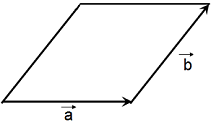
$\overrightarrow a = \widehat i - \widehat j + 3\widehat k$ and $\overrightarrow b = 2\widehat i - 7\widehat j + \widehat k$
Area of parallelogram $ = \left| {\overrightarrow a \times \overrightarrow b } \right|$
$\overrightarrow a \times \overrightarrow b = \left| {\begin{array}{*{20}{c}}{\widehat i}&{\widehat j}&{\widehat k}\\1&{ - 1}&3\\2&{ - 7}&1\end{array}} \right|$
$\overrightarrow a \times \overrightarrow b = 20\widehat i + 5\widehat j - 5\widehat k$
$\left| {\overrightarrow a \times \overrightarrow b } \right| = \sqrt {{{\left( {20} \right)}^2} + {{\left( 5 \right)}^2} - {{\left( 5 \right)}^2}} $
$\left| {\overrightarrow a \times \overrightarrow b } \right| = \sqrt {400 + 25 + 25} $
$\left| {\overrightarrow a \times \overrightarrow b } \right| = \sqrt {450} = 15\sqrt 2 $
∴ Area of parallelogram = $15\sqrt 2 $ square unit
Question (11)
Let vectors $\overrightarrow a$ and $\overrightarrow b$ be such that $\left| {\overrightarrow a } \right| = 3$ and $\left| {\overrightarrow b } \right| = \frac{{\sqrt 2 }}{3}$, then $\overrightarrow a \times \overrightarrow b $ is a unit vector, if the anglebetween $\overrightarrow a $ and $\overrightarrow b $ is(A) $\frac{\pi }{6}$ (B) $\frac{\pi }{4}$
(C) $\frac{\pi }{3}$ (D) $\frac{\pi }{2}$
Solution
$\left| {\overrightarrow a } \right| = 3,\left| {\overrightarrow b } \right| = \frac{{\sqrt 2 }}{3}$ $\overrightarrow a \times \overrightarrow b $ is unit vector$ \therefore \left| {\overrightarrow a \times \overrightarrow b } \right| = 1$
$\left| {\overrightarrow a \times \overrightarrow b } \right| = \left| {\overrightarrow a } \right|\left| {\overrightarrow b } \right|\sin \theta $
$1 = \require{cancel} \cancel{3} \cdot \frac{{\sqrt 2 }}{\cancel{3}}\sin \theta $
$1 = \sqrt 2 \sin \theta $
$\sin \theta = \frac{1}{{\sqrt 2 }}$
\[\theta = {\sin ^{ - 1}}\left( {\frac{1}{{\sqrt 2 }}} \right)\] $\theta = \frac{\pi }{4}$
∴ B is correct option
Question (12)
Area of a rectangle having vertices A, B, C and D with position vectors$ - \widehat i + \frac{1}{2}\widehat j + 4k$, $ \widehat i + \frac{1}{2}\widehat j + 4k$, $ \widehat i - \frac{1}{2}\widehat j + 4k$, and $ - \widehat i - \frac{1}{2}\widehat j + 4k$, respectively is
(A) $\frac{1}{2}$ (B) 1
(C) 2 (D) 4
Solution
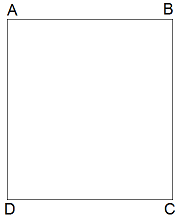
\[A\left( { - \widehat i + \frac{1}{2}\widehat j + 4\widehat k} \right)\] \[B\left( {\widehat i + \frac{1}{2}\widehat j + 4\widehat k} \right)\] \[C\left( {\widehat i - \frac{1}{2}\widehat j + 4\widehat k} \right)\] \[D\left( { - \widehat i - \frac{1}{2}\widehat j + 4\widehat k} \right)\] \[\overrightarrow {AB} = \overrightarrow b - \overrightarrow a \] \[\overrightarrow {AB} = 2\widehat i\] \[\overrightarrow {BC} = \overrightarrow c - \overrightarrow b \] \[\overrightarrow {BC} = - \widehat j\] \[ \text{Area of rectangle} = \left| {\overrightarrow {AB} \times \overrightarrow {BC} } \right|\] \[\overrightarrow {AB} \times \overrightarrow {BC} = \left| {\begin{array}{*{20}{c}}{\widehat i}&{\widehat j}&{\widehat k}\\2&0&0\\0&{ - 1}&0\end{array}} \right|\] \[\overrightarrow {AB} \times \overrightarrow {BC} = 0\widehat i - 0\widehat j - 2\widehat k\] \[\left| {\overrightarrow {AB} \times \overrightarrow {BC} } \right| = \sqrt {0 + 0 + 4} = 2\] Area of rectangle = 2
∴ C is correct option