Question (1)
Compute the magnitude of the following vectors:$\overrightarrow a = \widehat i + \widehat j + \widehat k$
$\overrightarrow b = 2\widehat i - 7\widehat j - 3\widehat k$
$\overrightarrow c = \frac{1}{{\sqrt 3 }}\widehat i + \frac{1}{{\sqrt 3 }}\widehat j - \frac{1}{{\sqrt 3 }}\widehat k$
Solution
$\overrightarrow a = \widehat i + \widehat j + \widehat k$$\overrightarrow b = 2\widehat i - 7\widehat j - 3\widehat k$
$\overrightarrow c = \frac{1}{{\sqrt 3 }}\widehat i + \frac{1}{{\sqrt 3 }}\widehat j - \frac{1}{{\sqrt 3 }}\widehat k$
\[\left| {\overrightarrow a } \right| = \sqrt {1 + 1 + 1} = 3\] \[\left| {\overrightarrow b } \right| = \sqrt {4 + 49 + 9} = \sqrt {62} \] \[\left| {\overrightarrow c } \right| = \sqrt {\frac{1}{3} + \frac{1}{3} + \frac{1}{3}} = 1\]
Question (2)
Two different vectors having same magnitudeSolution
\[\overrightarrow a = 2\widehat i + \widehat j - \widehat k\] \[\overrightarrow b = \widehat i + 2\widehat j + \widehat k\]Question (3)
Two vectors havings same directionSolution
\[\overrightarrow a = 2\widehat i + \widehat j - 3\widehat k\] \[\overrightarrow b = 4\widehat i + 2\widehat j - 6\widehat k\]Question (4)
Find the values of x and y so that the vectors $\overrightarrow a = 2\widehat i + 3\widehat j$ and $\overrightarrow b = x\hat i + y\hat j$ are equalSolution
\[\overrightarrow a = 2\widehat i + 3\widehat j\] \[\overrightarrow b = x\hat i + y\hat j\] Vectors are equal \[\overrightarrow a = \overrightarrow b \] \[2\widehat i + 3\widehat j = x\hat i + y\hat j\] \[x = 2,\quad y = 3\]Question (5)
Find the scalar and vector components of the vector with initial point (2, 1) and terminal point (-5, 7).Solution
\[A\left( {2,1} \right)\qquad B\left( { - 5,7} \right)\] \[\overrightarrow {AB} = \left( { - 5 - 2} \right)\widehat i + \left( {7 - 1} \right)\widehat j\] \[\overrightarrow {AB} = - 7\widehat i + 6\widehat j\]Question (6)
Find the sum of vectrs $\overrightarrow a = \widehat i - 2\widehat j + \widehat k$, $\overrightarrow b = - 2\widehat i + 4\widehat j + 5\widehat k$ and $\overrightarrow c = \widehat i - 6\widehat j - 7\widehat k$Solution
\[\overrightarrow a = \widehat i - 2\widehat j + \widehat k\] \[\overrightarrow b = - 2\widehat i + 4\widehat j + 5\widehat k\] \[\overrightarrow c = \widehat i - 6\widehat j - 7\widehat k\] \[\overrightarrow a + \overrightarrow b + \overrightarrow c = 0\widehat i - 4\widehat j - \widehat k\]Question (7)
Find the unit vector in the direction of vector $\overrightarrow a = \widehat i + \widehat j + 2\widehat k$Solution
\[\overrightarrow a = \widehat i + \widehat j + 2\widehat k\] \[\therefore \left| {\overrightarrow a } \right| = \sqrt {1 + 1 + 4} = \sqrt 6 \] \[\text{Unit vector}\quad \widehat a = \frac{{\overrightarrow a }}{{\left| {\overrightarrow a } \right|}}\] \[\widehat a = \frac{1}{{\sqrt 6 }}\widehat i + \frac{1}{{\sqrt 6 }}\widehat j + \frac{1}{{\sqrt 6 }}\widehat k\]Question (8)
Find the unit vector in in the direction of vector $\overrightarrow {PQ} $, where P and Q are the points (1,2,3) and (4, 5, 6) respectivelySolution
\[P\left( {1,2,3} \right)\qquad Q\left( {4,5,6} \right)\] \[\overrightarrow {PQ} = 3\widehat i + 3\widehat j + 3\widehat k\] \[\left| {\overrightarrow {PQ} } \right| = \sqrt {9 + 9 + 9} = \sqrt {27} = 3\sqrt 3 \] \[\widehat {PQ} = \frac{{\overrightarrow {PQ} }}{{\left| {\overrightarrow {PQ} } \right|}}\] \[\widehat {PQ} = \frac{{3\widehat i + 3\widehat j + 3\widehat k}}{{3\sqrt 3 }}\] \[\widehat {PQ} = \frac{1}{{3\sqrt 3 }}\widehat i + \frac{1}{{3\sqrt 3 }}\widehat j + \frac{1}{{3\sqrt 3 }}\widehat k\]Question (9)
For given vector $\overrightarrow a = 2\widehat i - \widehat j + 2\widehat k$ and $\overrightarrow b = - \widehat i + \widehat j - \widehat k$, find the unit vector in the direction of the vector $\overrightarrow a + \overrightarrow b $Solution
\[\overrightarrow a = 2\widehat i - \widehat j + 2\widehat k\] \[\overrightarrow b = - \widehat i + \widehat j - \widehat k\] \[\overrightarrow a + \overrightarrow b = 2\widehat i - \widehat j + 2\widehat k - \widehat i + \widehat j - \widehat k\] \[\overrightarrow a + \overrightarrow b = \widehat i + \widehat k\] \[\left| {\overrightarrow a + \overrightarrow b } \right| = \sqrt {1 + 1} = \sqrt 2 \] \[\frac{{\overrightarrow a + \overrightarrow b }}{{\left| {\overrightarrow a + \overrightarrow b } \right|}} = \frac{{\widehat i + \widehat j}}{{\sqrt 2 }} = \frac{1}{{\sqrt 2 }}\widehat i + \frac{1}{{\sqrt 2 }}\widehat k\]Question (10)
Find a vector in the direction of vector $\overrightarrow a = 5\widehat i - \widehat j + 2\widehat k$, which has magnitude 8 unitsSolution
\[\overrightarrow a = 5\widehat i - \widehat j + 2\widehat k\] \[\left| {\overrightarrow a } \right| = \sqrt {25 + 1 + 4} = \sqrt {30} \] \[\text{vector of magnitude 8} = 8\frac{{\overrightarrow a }}{{\left| {\overrightarrow a } \right|}}\] \[ = 8\frac{{\left( {5\widehat i - \widehat j + 2\widehat k} \right)}}{{\sqrt {30} }}\] \[ = \frac{{40}}{{\sqrt {30} }}\widehat i - \frac{8}{{\sqrt {30} }}\widehat j + \frac{{16}}{{\sqrt {30} }}\widehat k\]Question (11)
Show that $\overrightarrow a = 2\widehat i - 3\widehat j + 4\widehat k$ and $\overrightarrow b = - 4\widehat i + 6\widehat j - 8\widehat k$ are collinearSolution
\[\overrightarrow a = 2\widehat i - 3\widehat j + 4\widehat k\] \[\overrightarrow b = - 4\widehat i + 6\widehat j - 8\widehat k\] \[\overrightarrow a \times \overrightarrow b = \left| {\begin{array}{*{20}{c}}{\widehat i}&{\widehat j}&{\widehat k}\\2&{ - 3}&4\\{ - 4}&6&{ - 8}\end{array}} \right|\] \[\overrightarrow a \times \overrightarrow b = \left( {24 - 24} \right)\widehat i - \left( { - 16 + 16} \right)\widehat j + \left( {12 - 12} \right)\widehat k\] \[\overrightarrow a \times \overrightarrow b = \overrightarrow 0 \] ⇒ $\overrightarrow a $ and $\overrightarrow b $ are both collinearQuestion (12)
Find the direction cosine of the vector $\overrightarrow a = \widehat i + 2\widehat j + 3\widehat k$Solution
\[\overrightarrow a = \widehat i + 2\widehat j + 3\widehat k\] \[\left| {\overrightarrow a } \right| = \sqrt {1 + 4 + 9} = \sqrt {14} \] \[\widehat a = \frac{{\overrightarrow a }}{{\left| {\overrightarrow a } \right|}}\] \[\widehat a = \frac{{\widehat i + 2\widehat j + 3\widehat k}}{{\sqrt {14} }}\] \[\text{cosine direction} = \left( {\frac{1}{{\sqrt {14} }},\frac{2}{{\sqrt {14} }},\frac{3}{{\sqrt {14} }}} \right)\]Question (13)
Find the direction cosines of the vector joining the points A(1, 2, -3) and B(-1, -2, 1), directed from A to BSolution
\[A\left( {1,2, - 3} \right),\text{and} \quad B\left( { - 1, - 2,1} \right)\] \[\overrightarrow {AB} = \left( { - 1, - 2,1} \right) - \left( {1,2, - 3} \right)\] \[\overrightarrow {AB} = \left( { - 2, - 4,4} \right)\] \[\overrightarrow {AB} = - 2\widehat i - 4\widehat j + 4\widehat k\] \[\left| {\overrightarrow {AB} } \right| = \sqrt {4 + 16 + 16} = \sqrt {36} = 6\] \[\text{Direction cosine} = \frac{{\overrightarrow {AB} }}{{\left| {\overrightarrow {AB} } \right|}}\] \[\text{Direction cosine} = \frac{{ - 2\widehat i - 4\widehat j + 4\widehat k}}{6}\] \[\text{Direction cosine} = \frac{{ - 1}}{3}\widehat i - \frac{2}{3}\widehat j + \frac{2}{3}\widehat k\]Question (14)
Show that vector $\overrightarrow a = \widehat i + \widehat j + \widehat k$ is equally iinclined to the axes OX, OY and OZSolution
\[\overrightarrow a = \widehat i + \widehat j + \widehat k\] \[\left| {\overrightarrow a } \right| = \sqrt {1 + 1 + 1} = \sqrt 3 \] \[\text{cosine direction} = \frac{{\overrightarrow a }}{{\left| {\overrightarrow a } \right|}}\] \[\text{cosine direction} = \frac{{\widehat i + \widehat j + \widehat k}}{{\sqrt 3 }}\] \[\left( {\cos \alpha ,\cos \beta ,\cos \delta } \right) = \left( {\frac{1}{{\sqrt 3 }},\frac{1}{{\sqrt 3 }},\frac{1}{{\sqrt 3 }}} \right)\] \[\cos \alpha = \frac{1}{{\sqrt 3 }}\] \[\alpha = {\cos ^{ - 1}}\left( {\frac{1}{{\sqrt 3 }}} \right)\] \[\beta = \gamma = {\cos ^{ - 1}}\left( {\frac{1}{{\sqrt 3 }}} \right)\] \[\text{as } \quad \alpha = \beta = \gamma \] so it is equally inclinedQuestion (15)
Find the position vector of a point R which divides the line joining two points P and Q whose position vector of a point R which divides the line joining two points P and Q whose position vectors are $\overrightarrow p = \widehat i + 2\widehat j - \widehat k\quad and \quad \overrightarrow q = - \widehat i + \widehat j + \widehat k$ respectively, in the ratio 2:1(i) internally and (ii) externally
Solution
\[\overrightarrow p = \widehat i + 2\widehat j - \widehat k\quad and \quad \overrightarrow q = - \widehat i + \widehat j + \widehat k\] (i) internally$R\left( {\overrightarrow r } \right)$ divide $\overrightarrow {PQ} $ internally in ratio 2:1
\[\therefore \overrightarrow r = \frac{{2\overrightarrow q + \overrightarrow q }}{{2 + 1}}\] \[\overrightarrow r = \frac{{2\left( { - \widehat i + \widehat j + \widehat k} \right) + \left( {\widehat i + 2\widehat j - \widehat k} \right)}}{3}\] \[\overrightarrow r = \frac{{ - \widehat i + 4\widehat j + \widehat k}}{3}\]
(ii) External
R divides PQ externally in ratio 2:1
\[\overrightarrow r = \frac{{2\left( { - \widehat i + \widehat j + \widehat k} \right) + \left( {\widehat i + 2\widehat j - \widehat k} \right)}}{{ - 1}}\] \[\overrightarrow r = \frac{{3\widehat i + 0\widehat j - 3\widehat k}}{{ - 1}}\] \[\overrightarrow r = - 3\widehat i + 3\widehat k\]
Question (16)
Find the position vector of the mid point of the vector jpining the points P(2, 3, 4) and Q(4, 1, -2)Solution
\[P\left( {2,3,4} \right),\quad and \quad Q\left( {4,1, - 2} \right)\] Let R is mid point of $\overrightarrow {PQ} $\[\therefore \overrightarrow r = \frac{{\overrightarrow p + \overrightarrow q }}{2}\] \[\overrightarrow r = \left( {\frac{{2 + 4}}{2},\frac{{3 + 1}}{2},\frac{{4 - 2}}{2}} \right)\] \[\overrightarrow r = \left( {3,2,1} \right)\]
Question (17)
Show that the points A, B, and C with position vectors $ {\overrightarrow a } = 3\widehat i - 4\widehat j - 4\widehat k$ , $ {\overrightarrow b } = 2\widehat i - \widehat j + \widehat k$ and $ {\overrightarrow c } = \widehat i - 3\widehat j - 5\widehat k$Solution
\[A\left( {\overrightarrow a } \right) = 3\widehat i - 4\widehat j - 4\widehat k\] \[B\left( {\overrightarrow b } \right) = 2\widehat i - \widehat j + \widehat k\] \[C\left( {\overrightarrow c } \right) = \widehat i - 3\widehat j - 5\widehat k\] \[\overrightarrow {AB} = \overrightarrow b - \overrightarrow a = - \widehat i + 3\widehat j + 5\widehat k\] \[AB = \left| {\overrightarrow {AB} } \right| = \sqrt {1 + 9 + 25} = \sqrt {35} \] \[\overrightarrow {BC} = \overrightarrow c - \overrightarrow b = - \widehat i - 2\widehat j - 6\widehat k\] \[BC = \overrightarrow {BC} = \sqrt {1 + 4 + 36} = \sqrt {41} \] \[\overrightarrow {AC} = \overrightarrow c - \overrightarrow a = - 2\widehat i + \widehat j - \widehat k\] \[AC = \overrightarrow {AC} = \sqrt {4 + 1 + 1} = \sqrt 6 \] \[A{B^2} + A{C^2} = 35 + 6\] \[A{B^2} + A{C^2} = 41\] \[A{B^2} + A{C^2} = B{C^2}\] ⇒ By converse of Pythagorus ∠A =90° is right angle in δABC\[\overrightarrow {AB \cdot } \overrightarrow {AC} = \left( { - \widehat i + 3\widehat j + 5\widehat k} \right) \cdot \left( { - 2\widehat i + \widehat j - \widehat k} \right)\] \[\overrightarrow {AB \cdot } \overrightarrow {AC} = 2 + 3 - 5 = 0\] \[ \Rightarrow \overrightarrow {AB} \bot \overrightarrow {AC} \] \[ \Rightarrow \angle A = 90\]
Question (18)
In traiangle ABC (Fig 10.18), which of the following is not true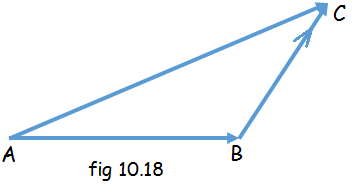
$(A) \quad \overrightarrow {AB} + \overrightarrow {BC} + \overrightarrow {CA} = \overrightarrow 0 $
$(B) \quad\overrightarrow {AB} + \overrightarrow {BC} - \overrightarrow {AC} = \overrightarrow 0 $
$(C) \quad \overrightarrow {AB} + \overrightarrow {BC} - \overrightarrow {CA} = \overrightarrow 0 $
$(D) \quad \overrightarrow {AB} - \overrightarrow {CB} + \overrightarrow {CA} = \overrightarrow 0 $
Solution
\[\text{By triangle law}\overrightarrow {AB} + \overrightarrow {BC} = \overrightarrow {AC} \] \[\overrightarrow {AB} + \overrightarrow {BC} - \overrightarrow {AC} = 0\] \[\overrightarrow {AB} + \overrightarrow {BC} + \overrightarrow {CA} = 0\] not correctQuestion (19)
If &\overrightarrow a & and &\overrightarrow b & are two collinear vectors, then which of the following are incorrect$ (A) \ quad \overrightarrow b = \lambda \overrightarrow a $, for some scalar λ
$(B) \quad \overrightarrow a = \pm \overrightarrow b $
(C) the respective components of &\overrightarrow a & and &\overrightarrow b & are not proportional
(D) both the vectors &\overrightarrow a & and &\overrightarrow b & have same direction, but different magniitudes
Solution
\[\overrightarrow a \quad and \quad \overrightarrow b \text{colliner then}\] \[\overrightarrow b = \lambda \overrightarrow a \]