Question (1)
Find the angle between two vectors $\overrightarrow a $ and $\overrightarrow b$ with magnitude $\sqrt 3 $ and 2, respectively having$\overrightarrow a \cdot \overrightarrow b = \sqrt 6 $
Solution
\[\left| {\overrightarrow a } \right| = \sqrt 3 ,\left| {\overrightarrow b } \right| = 2\] \[\overrightarrow a \cdot \overrightarrow b = \sqrt 6 \] Let θ be angle between $\overrightarrow a $ and $\overrightarrow b $ then \[\cos \theta = \frac{{\overrightarrow a \cdot \overrightarrow b }}{{\left| {\overrightarrow a } \right|\left| {\overrightarrow b } \right|}}\] \[\cos \theta = \frac{{\sqrt 6 }}{{\sqrt 3 \cdot 2}}\] \[\cos \theta = \frac{{\sqrt 2 }}{2} = \frac{1}{{\sqrt 2 }}\] \[\theta = \cos \left( {\frac{1}{{\sqrt 2 }}} \right) = \frac{\pi }{4}\]Question (2)
Find the angle between the vectors $\widehat i - 2\widehat j + 3\widehat k$ and $3\widehat i - 2\widehat j + \widehat k$Solution
$\overrightarrow a = \widehat i - 2\widehat j + 3\widehat k$$\overrightarrow b = 3\widehat i - 2\widehat j + \widehat k$
Let θ be angle between $\overrightarrow a $ and $\overrightarrow b $
\[\cos \theta = \frac{{\left( {\widehat i - 2\widehat j + 3\widehat k} \right) \cdot \left( {3\widehat i - 2\widehat j + \widehat k} \right)}}{{\sqrt {1 + 4 + 9} \cdot \sqrt {9 + 4 + 1} }}\] \[\cos \theta = \frac{{3 + 4 + 3}}{{\sqrt {14} \cdot \sqrt {14} }}\] \[\cos \theta = \frac{{\require{cancel} \cancel{10}^5}}{{\cancel{14}_7}}\] \[\cos \theta = \frac{5}{7}\] \[\theta = {\cos ^{ - 1}}\left( {\frac{5}{7}} \right)\]
Question (3)
Find the projection of the vector $\widehat i - \widehat j$ on vector $\widehat i + \widehat j$Solution
projection of the vector $\widehat i - \widehat j$ on vector $\widehat i + \widehat j = \frac{{\overrightarrow a \cdot \overrightarrow b }}{{\left| {\overrightarrow b } \right|}}$$\overrightarrow a = \widehat i - \widehat j$ and $\overrightarrow b = \widehat i + \widehat j$
\[projection = \frac{{\left( {\widehat i - \widehat j} \right) \cdot \left( {\widehat i + \widehat j} \right)}}{{\sqrt {1 + 1} }}\] \[projection = \frac{{1 - 1}}{{\sqrt 2 }} = 0\]
Question (4)
Find the projection of the vector $\widehat i + 3\widehat j + 7\widehat k$ on the vector $7\widehat i - \widehat j + 8\widehat k$Solution
$\overrightarrow a = \hat i + 3\hat j + 7\hat k$ and $\overrightarrow b = 7\hat i - \hat j + 8\hat k$Projection of $\overrightarrow a on \overrightarrow b = \frac{{\overrightarrow a \cdot \overrightarrow b }}{{\left| {\overrightarrow b } \right|}} $ \[ = \frac{{\left( {\widehat i + 3\widehat j + 7\widehat k} \right) \cdot \left( {7\widehat i - \widehat j + 8\widehat k} \right)}}{{\sqrt {49 + 1 + 64} }}\] \[ = \frac{{7 - 3 + 56}}{{\sqrt {114} }} = \frac{{60}}{{\sqrt {114} }}\]
Question (5)
Show that each of the given three vectors is a unit vector: \[\frac{1}{7}\left( {2\widehat i + 3\widehat j + 6\widehat k} \right)\] \[\frac{1}{7}\left( {3\widehat i - 6\widehat j + 2\widehat k} \right)\] \[\frac{1}{7}\left( {6\widehat i + 2\widehat j - 3\widehat k} \right)\] Also, show that they are mutually perpendicular to each otherSolution
\[\overrightarrow a = \frac{1}{7}\left( {2\hat i + 3\hat j + 6\hat k} \right)\] \[\left| {\overrightarrow a } \right| = \sqrt {\frac{{4 + 9 + 36}}{{49}} = 1} \] \[\overrightarrow b = \frac{1}{7}\left( {3\hat i - 6\hat j + 2\hat k} \right)\] \[\left| {\overrightarrow b } \right| = \sqrt {\frac{{9 + 36 + 4}}{{49}}} = 1\] \[\overrightarrow c = \frac{1}{7}\left( {6\hat i + 2\hat j - 3\hat k} \right)\] \[\left| {\overrightarrow c } \right| = \sqrt {\frac{{36 + 4 + 9}}{{49}}} = 1\] \[\text {Now} \quad \overrightarrow a \cdot \overrightarrow b = \frac{1}{7}\left( {2\widehat i + 3\widehat j + 6\widehat k} \right) \cdot \frac{1}{7}\left( {3\widehat i - 6\widehat j + 2\widehat k} \right)\] \[\overrightarrow a \cdot \overrightarrow b = \frac{1}{{49}}\left( {6 - 18 + 12} \right) = 0\] ⇒ $\overrightarrow a $ ⊥ $\overrightarrow b $\[\overrightarrow b \cdot \overrightarrow c = \frac{1}{7}\left( {3\widehat i - 6\widehat j + 2\widehat k} \right) \cdot \frac{1}{7}\left( {6\widehat i + 2\widehat j - 3\widehat k} \right)\] \[\overrightarrow b \cdot \overrightarrow c = \frac{1}{{49}}\left( {18 - 12 - 6} \right) = 0\] ⇒ $\overrightarrow b $ ⊥ $\overrightarrow c $
\[\overrightarrow a \cdot \overrightarrow c = \frac{1}{7}\left( {2\widehat i + 3\widehat j + 6\widehat k} \right) \cdot \frac{1}{7}\left( {6\widehat i + 2\widehat j - 3\widehat k} \right)\] \[\overrightarrow a \cdot \overrightarrow c = \frac{1}{{49}}\left( {12 + 6 - 18} \right) = 0\] ⇒ $\overrightarrow a $ ⊥ $\overrightarrow c $
∴ vectors are mutually perpendicular
Question (6)
Find $\left| {\overrightarrow a } \right|$ and $\left| {\overrightarrow b } \right|$, if $\left( {\overrightarrow a + \overrightarrow b } \right) \cdot \left( {\overrightarrow a - \overrightarrow b } \right) = 8$ and $\left| {\overrightarrow a } \right| = 8\left| {\overrightarrow b } \right|$Solution
\[\left( {\overrightarrow a + \overrightarrow b } \right) \cdot \left( {\overrightarrow a - \overrightarrow b } \right) = 8\] \[\overrightarrow a \cdot \overrightarrow a - \overrightarrow a \cdot \overrightarrow b + \overrightarrow b \cdot \overrightarrow a - \overrightarrow b \cdot \overrightarrow b = 8\] \[{\left| {\overrightarrow a } \right|^2} - {\left| {\overrightarrow b } \right|^2} = 8\] \[{\left( {8\left| {\overrightarrow b } \right|} \right)^2} - {\left| {\overrightarrow b } \right|^2} = 8\] \[64{\left| {\overrightarrow b } \right|^2} - {\left| {\overrightarrow b } \right|^2} = 8\] \[63{\left| {\overrightarrow b } \right|^2} = 8\] \[{\left| {\overrightarrow b } \right|^2} = \frac{8}{{63}}\] \[\left| {\overrightarrow b } \right| = \sqrt {\frac{8}{{63}}} = \frac{2}{3}\sqrt {\frac{2}{7}} \]Question (7)
Evaluate the product $\left( {3\overrightarrow a - 5\overrightarrow b } \right) \cdot \left( {2\overrightarrow a + 7\overrightarrow b } \right)$Solution
\[\left( {3\overrightarrow a - 5\overrightarrow b } \right) \cdot \left( {2\overrightarrow a + 7\overrightarrow b } \right)\] \[ = 6\overrightarrow a \cdot \overrightarrow a + 21\overrightarrow a \cdot \overrightarrow b - 10\overrightarrow b \cdot \overrightarrow a - 35\overrightarrow b \cdot \overrightarrow b \] \[ = 6{\left| {\overrightarrow a } \right|^2} + 11\overrightarrow a \cdot \overrightarrow b - 35{\left| {\overrightarrow b } \right|^2}\]Question (8)
Find the magnitude of two vectors $\overrightarrow a $ and $\overrightarrow b $ , having the same magnitude and such that the angle between them is 60° and their scalar product is $\frac{1}{2}$Solution
\[\left| {\overrightarrow a } \right| = \left| {\overrightarrow b } \right|, \quad \theta = {60^o}, \quad \overrightarrow a \cdot \overrightarrow b = \frac{1}{2}\] \[\cos \theta = \frac{{\overrightarrow a \cdot \overrightarrow b }}{{\left| {\overrightarrow a } \right|\left| {\overrightarrow b } \right|}}\] \[\cos 60 = \frac{{\frac{1}{2}}}{{\left| {\overrightarrow a } \right|\left| {\overrightarrow b } \right|}}\] \[\frac{1}{2} = \frac{1}{2}\frac{1}{{{{\left| {\overrightarrow a } \right|}^2}}}\] \[{\left| {\overrightarrow a } \right|^2} = 1\] \[\left| {\overrightarrow a } \right| = 1\] \[\left| {\overrightarrow a } \right| = \left| {\overrightarrow b } \right| = 1\]Question (9)
Find \[\left| {\overrightarrow x } \right|\], if for a unit vector $\overrightarrow a $. $\left( {\overrightarrow x - \overrightarrow a } \right) \cdot \left( {\overrightarrow x + \overrightarrow a } \right) = 12$Solution
\[\left| {\overrightarrow a } \right| = 1\] \[\left( {\overrightarrow x - \overrightarrow a } \right) \cdot \left( {\overrightarrow x + \overrightarrow a } \right) = 12\] \[\overrightarrow x \cdot \overrightarrow x + \overrightarrow x \cdot \overrightarrow a - \overrightarrow a \cdot \overrightarrow x - \overrightarrow a \cdot \overrightarrow a = 12\] \[{\left| {\overrightarrow x } \right|^2} - {\left| {\overrightarrow a } \right|^2} = 12\] \[{\left| {\overrightarrow x } \right|^2} - 1 = 12\] \[{\left| {\overrightarrow x } \right|^2} = 13\] \[\left| {\overrightarrow x } \right| = \sqrt {13} \]Question (10)
$\overrightarrow a = 2\widehat i + 2\widehat j + 3\widehat k$$\overrightarrow b = - \widehat i + 2\widehat j + \widehat k$ and
$\overrightarrow c = 3\widehat i + \widehat j$
are such that $\overrightarrow a + \lambda \overrightarrow b $ is perpendicular to $\overrightarrow c $, then find value of λ
Solution
\[\overrightarrow a = 2\widehat i + 2\widehat j + 3\widehat k\] \[\overrightarrow b = - \widehat i + 2\widehat j + \widehat k\] \[ \text{As} \quad \overrightarrow a + \lambda \overrightarrow b \bot \overrightarrow c \] \[\left( {\overrightarrow a + \lambda \overrightarrow b } \right) \cdot \overrightarrow c = 0\] \[\overrightarrow a + \lambda \overrightarrow b = \left( {2\widehat i + 2\widehat j + 3\widehat k} \right) + \lambda \left( { - \widehat i + 2\widehat j + \widehat k} \right)\]\[\left( {\overrightarrow a + \lambda \overrightarrow b } \right) \cdot \overrightarrow c = 0\] \[\left[ {\left( {2 - \lambda } \right)\widehat i + \left( {2 + 2\lambda } \right)\widehat j + \left( {3 + \lambda } \right)\widehat k} \right] \cdot \left[ {3\widehat i + \widehat j} \right] = 0\] \[3\left( {2 - \lambda } \right) + \left( {2 + 2\lambda } \right) = 0\] \[6 - 3\lambda + 2 + 2\lambda = 0\] \[8 - \lambda = 0\] \[\lambda = 8\]
Question (11)
Show that $\left| {\overrightarrow a } \right|\overrightarrow b + \left| {\overrightarrow b } \right|\overrightarrow a $ is perpendicular to $\left| {\overrightarrow a } \right|\overrightarrow b - \left| {\overrightarrow b } \right|\overrightarrow a $, for any two nonzero vector $\overrightarrow a $ and $\overrightarrow a $Solution
\[\left[ {\left| {\overrightarrow a } \right|\overrightarrow b + \left| {\overrightarrow b } \right|\overrightarrow a } \right] \cdot \left[ {\left| {\overrightarrow a } \right|\overrightarrow b + \left| {\overrightarrow b } \right|\overrightarrow a } \right]\] \[ = {\left| {\overrightarrow a } \right|^2}\overrightarrow b \cdot \overrightarrow b + \left| {\overrightarrow a } \right|\overrightarrow b \cdot \left| {\overrightarrow b } \right|\overrightarrow a - \left| {\overrightarrow b } \right|\overrightarrow a \cdot \left| {\overrightarrow a } \right|\overrightarrow b - \left| {\overrightarrow b } \right|\left| {\overrightarrow b } \right|\overrightarrow a \overrightarrow a \] \[ = {\left| {\overrightarrow a } \right|^2}{\left| {\overrightarrow b } \right|^2} + \left| {\overrightarrow a } \right|\left| {\overrightarrow b } \right|\overrightarrow {a \cdot } \overrightarrow b - \left| {\overrightarrow a } \right|\left| {\overrightarrow b } \right|\overrightarrow {a \cdot } \overrightarrow b - {\left| {\overrightarrow b } \right|^2}{\left| {\overrightarrow a } \right|^2}\] \[ = 0\] \[ \Rightarrow \left( {\left| {\overrightarrow a } \right|\overrightarrow b + \left| {\overrightarrow b } \right|\overrightarrow a } \right) \bot \left| {\overrightarrow a } \right|\overrightarrow b - \left| {\overrightarrow b } \right|\overrightarrow a \]Question (12)
If $\overrightarrow a \cdot \overrightarrow a = 0$ and $\overrightarrow a \cdot \overrightarrow b = 0$ , then what can be cocluded about the vector $\overrightarrow b $ ?Solution
\[\overrightarrow a \cdot \overrightarrow a = 0, \quad \overrightarrow a \cdot \overrightarrow b = 0\] \[{\left| {\overrightarrow a } \right|^2} = 0, \quad 0 \cdot \overrightarrow b = 0\] \[\text{since} \quad \overrightarrow a = \overrightarrow 0 ,\quad \overrightarrow b \text{can be any vector} \]Question (13)
If $\overrightarrow a $, $\overrightarrow b $, $\overrightarrow c $ are uniit vectors such that $\overrightarrow a + \overrightarrow b + \overrightarrow c = \overrightarrow 0 $, find the value of$\overrightarrow a \cdot \overrightarrow b + \overrightarrow b \cdot \overrightarrow c + \overrightarrow c \cdot \overrightarrow a $
Solution
\[\overrightarrow a + \overrightarrow b + \overrightarrow c = 0\] \[{\left( {\overrightarrow a + \overrightarrow b + \overrightarrow c } \right)^2} = 0\] \[\left( {\overrightarrow a + \overrightarrow b + \overrightarrow c } \right) \cdot \left( {\overrightarrow a + \overrightarrow b + \overrightarrow c } \right) = 0\] \[\overrightarrow a \cdot \overrightarrow a + \overrightarrow a \cdot \overrightarrow b + \overrightarrow a \cdot \overrightarrow c + \overrightarrow b \cdot \overrightarrow a + \overrightarrow b \cdot \overrightarrow b + \overrightarrow b \cdot \overrightarrow c + \overrightarrow c \cdot \overrightarrow a + \overrightarrow c \cdot \overrightarrow b + \overrightarrow c \cdot \overrightarrow c = 0\] \[{\left| {\overrightarrow a } \right|^2} + {\left| {\overrightarrow b } \right|^2} + {\left| {\overrightarrow c } \right|^2} + 2\left( {\overrightarrow a \cdot \overrightarrow b + \overrightarrow b \cdot \overrightarrow c + \overrightarrow c \cdot \overrightarrow a } \right) = 0\] \[1 + 1 + 1 + 2\left( {\overrightarrow a \cdot \overrightarrow b + \overrightarrow b \cdot \overrightarrow c + \overrightarrow c \cdot \overrightarrow a } \right) = 0\] \[\overrightarrow a \cdot \overrightarrow b + \overrightarrow b \cdot \overrightarrow c + \overrightarrow c \cdot \overrightarrow a = \frac{{ - 3}}{2}\]Question (14)
If either vector $\overrightarrow a = \overrightarrow 0 $ or $\overrightarrow b = \overrightarrow 0 $, then $\overrightarrow a \cdot \overrightarrow b = 0$. But the converse need not be true. Justify your answer with an exampleSolution
\[\overrightarrow a = 0,\overrightarrow b = 0\] \[\text{then} \quad \overrightarrow a \cdot \overrightarrow b = \left| {\overrightarrow a } \right| \cdot \left| {\overrightarrow b } \right|\cos \theta = 0\] \[text{If} \quad \overrightarrow a \cdot \overrightarrow b = 0\] \[ \Rightarrow \left| {\overrightarrow a } \right| = 0 \quad OR\left| {\overrightarrow b } \right| = 0 \quad OR\overrightarrow a \bot \overrightarrow b \] so converse statement is not trueQuestion (15)
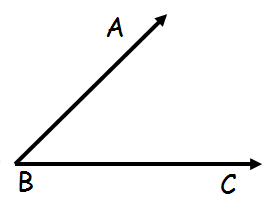 If the vertices A, B, C of a triangle ABC are (1, 2, 3), (-1, 0, 0), (0, 1,2), respectively, then find ∠ABC. [ ∠ABC is the angle between the vector $\overrightarrow {BA} $ and $\overrightarrow {BC} $]
Solution
A(1, 2, 3), B(-1, 0, 0), C(0, 1, 2) \[\cos \angle ABC = \frac{{\overrightarrow {BA} \cdot \overrightarrow {BC} }}{{\left| {\overrightarrow {BA} } \right| \cdot \left| {\overrightarrow {BC} } \right|}}\] \[\overrightarrow {BA} = \left( {1,2,3} \right) - \left( { - 1,0,0} \right)\] \[\overrightarrow {BA} = \left( {2,2,3} \right)\] \[\overrightarrow {BC} = \left( {0,1,2} \right) - \left( { - 1,0,0} \right)\] \[\overrightarrow {BC} = \left( {1,1,2} \right)\] \[\cos \angle ABC = \frac{{\overrightarrow {BA} \cdot \overrightarrow {BC} }}{{\left| {\overrightarrow {BA} } \right| \cdot \left| {\overrightarrow {BC} } \right|}}\] \[\cos \angle ABC = \frac{{\left( {2,2,3} \right) \cdot \left( {1,1,2} \right)}}{{\sqrt {4 + 4 + 9} \sqrt {1 + 1 + 4} }}\] \[\cos \angle ABC = \frac{{2 + 2 + 6}}{{\sqrt {17} \sqrt 6 }}\] \[\cos \angle ABC = \frac{{10}}{{\sqrt {102} }}\] \[\angle ABC = {\cos ^{ - 1}}\left( {\frac{{10}}{{\sqrt {102} }}} \right)\]Question (16)
Show that the point A(1, 2, 7), B(2, 6, 3) and C (3, 10, -1) are collinearSolution
A(1, 2, 7), B(2, 6, 3) and C (3, 10, -1) \[\overrightarrow {AB} = \left( {2,6,3} \right) - \left( {1,2,7} \right) = \left( {1,4, - 4} \right)\] \[\overrightarrow {BC} = \left( {3,10, - 1} \right) - \left( {2,6,3} \right) = \left( {1,4, - 4} \right)\] \[\overrightarrow {AB} = \overrightarrow {BC} \] \[ \Rightarrow \lambda = 1\] so vectors are collinearQuestion (17)
Show that the vectors $2\widehat i - \widehat j + \widehat k$, $\widehat i - 3\widehat j - 5\widehat k$ and $3\widehat i - 4\widehat j - 4\widehat k$ form the verices of a right angled triangle.Solution
\[\overrightarrow a = 2\hat i - \hat j + \hat k\] \[\overrightarrow b = \hat i - 3\hat j - 5\hat k\] \[\overrightarrow c = 2\hat i - 4\hat j - 4\hat k\] \[\overrightarrow a \cdot \overrightarrow b = \left( {2\widehat i - \widehat j + \widehat k} \right) \cdot \left( {\widehat i - 3\widehat i - 5\widehat k} \right)\] \[\overrightarrow a \cdot \overrightarrow b = 2 + 3 + 5 = 0\] \[ \Rightarrow \overrightarrow a \bot \overrightarrow b \] So they are are side of right angle traingleQuestion (18)
If $\overrightarrow a $ is a nonzero vector of magnitude 'a' and λ a nonzero scalar, then λ$\overrightarrow a $ is unit vector if(A) λ = 1 (B) λ = -1
(C) a = |λ| (D) $a = \frac{1}{{\left| \lambda \right|}}$
Solution
\[\left| {\overrightarrow a } \right| = \lambda \overrightarrow a \] \[\lambda = 1\] So A is a correct option