Question (1)
Three vertices of a parallelogram ABCD are A (3, –1, 2), B (1, 2, –4) andC (–1, 1, 2). Find the coordinates of the fourth vertex.Solution
The three vertices of a parallelogram ABCD are given as A (3, –1, 2), B (1, 2, –4), and C (–1, 1, 2). Let the coordinates of the fourth vertex be D (x, y, z).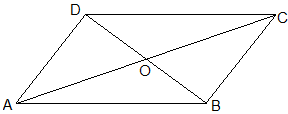
We know that the diagonals of a parallelogram bisect each other.
Therefore, in parallelogram ABCD, AC and BD bisect each other.
∴ Mid-point of AC = Mid-point of BD
$ \Rightarrow \left( {\frac{{3 - 1}}{2},\frac{{ - 1 + 1}}{2},\frac{{2 + 2}}{2}} \right) = \left( {\frac{{x + 1}}{2},\frac{{y + 2}}{2},\frac{{z - 4}}{2}} \right)$
$ \Rightarrow \left( {1,0,2} \right) = \left( {\frac{{x + 1}}{2},\frac{{y + 2}}{2},\frac{{z - 4}}{2}} \right)$
$ \Rightarrow \frac{{x + 1}}{2} = 1,\frac{{y + 2}}{2} = 0,and\frac{{z - 4}}{2} = 2$
⇒ x = 1, y = –2, and z = 8
Thus, the coordinates of the fourth vertex are (1, –2, 8).
Question (2)
Find the lengths of the medians of the triangle with vertices A (0, 0, 6), B (0, 4, 0) and (6, 0, 0).Solution
Let AD, BE, and CF be the medians of the given triangle ABC.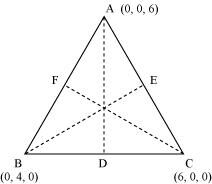
Since AD is the median, D is the mid-point of BC.
∴ Coordinates of point D $ = \left( {\frac{{0 + 6}}{2},\frac{{4 + 0}}{2},\frac{{0 + 0}}{2}} \right) = \left( {3,2,0} \right)$
$AD = \sqrt {{{\left( {0 - 3} \right)}^2} + {{\left( {0 - 2} \right)}^2} + {{\left( {6 - 0} \right)}^2}} $
$AD = \sqrt {9 + 4 + 36} = \sqrt {49} = 7$
Since BE is the median, E is the mid-point of AC.
∴ Coordinates of point $E = \left( {\frac{{0 + 6}}{2},\frac{{0 + 0}}{2},\frac{{6 + 0}}{2}} \right) = \left( {3,0,3} \right)$
$BE = \sqrt {{{\left( {3 - 0} \right)}^2} + {{\left( {0 - 4} \right)}^2} + {{\left( {3 - 0} \right)}^2}} $
$BE = \sqrt {9 + 16 + 9} = \sqrt {34} $
Since CF is the median, F is the mid-point of AB
∴ Coordinates of point $F = \left( {\frac{{0 + 0}}{2},\frac{{0 + 4}}{2},\frac{{6 + 0}}{2}} \right) = \left( {0,2,3} \right)$
Length of $CF = \sqrt {{{\left( {6 - 0} \right)}^2} + {{\left( {0 - 2} \right)}^2} + {{\left( {0 - 3} \right)}^2}} $
$CF = \sqrt {36 + 4 + 9} = \sqrt {49} = 7$
Thus, the lengths of the medians of ΔABC are $7,\sqrt {34} and7$
Question (3)
If the origin is the centroid of the triangle PQR with vertices P (2a, 2, 6), Q (–4, 3b, –10) and R (8, 14, 2c), then find the values of a, b and c.Solution
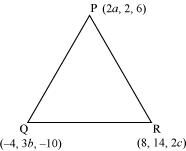
It is known that the coordinates of the centroid of the triangle, whose vertices are (x1, y1, z1), (x2, y2, z2) and (x3, y3, z3), are
$\left( {\frac{{{x_1} + {x_2} + {x_3}}}{3},\frac{{{y_1} + {y_2} + {y_3}}}{3},\frac{{{z_1} + {z_2} + {z_3}}}{3}} \right)$
Therefore, coordinates of the centroid of ΔPQR
$ = \left( {\frac{{2a - 4 + 8}}{3},\frac{{2 + 3b + 14}}{3},\frac{{6 - 10 + 2c}}{3}} \right) = \left( {\frac{{2a + 4}}{3},\frac{{3b + 16}}{3},\frac{{2c - 4}}{3}} \right)$ It is given that origin is the centroid of ΔPQR.
$\therefore \left( {0,0,0} \right) = \left( {\frac{{2a + 4}}{3},\frac{{3b + 16}}{3},\frac{{2c - 4}}{3}} \right)$
$ \Rightarrow \frac{{2a + 4}}{3} = 0,\frac{{3b + 16}}{3} = 0\;and\;\frac{{2c - 4}}{3} = 0$
$ \Rightarrow a = - 2,b = - \frac{{16}}{3} \;and\; c = 2$
Thus, the respective values of a, b, and c are $ - 2, - \frac{{16}}{3},and2$
Question (4)
Find the coordinates of a point on y-axis which are at a distance of 5√2 from the point P (3, –2, 5).Solution
If a point is on the y-axis, then x-coordinate and the z-coordinate of the point are zero.Let A (0, b, 0) be the point on the y-axis at a distance of 5√2 from point P (3, –2, 5). Accordingly AP = 5√2,
∴ AP2 = 50
⇒ (3-0)2 + (-2-b)2 + (5-0)2 = 50
⇒ 9 + 4 +b2 + 4b + 25 = 50
⇒ b2 + 4b -12 = 0
⇒ b2 + 6b - 2b -12 = 0
⇒ (b+6) ( b-2) = 0
⇒ b = -6 or 2
Thus, the coordinates of the required points are (0, 2, 0) and (0, –6, 0).
Question (5)
A point R with x-coordinate 4 lies on the line segment joining the pointsP (2, –3, 4) and Q (8, 0, 10). Find the coordinates of the point R.[Hint suppose R divides PQ in the ratio k: 1. The coordinates of the point R are given by $\left( {\frac{{8k + 2}}{{k + 1}},\frac{{ - 3}}{{k + 1}},\frac{{10k + 4}}{{k + 1}}} \right)$ ]
Solution
The coordinates of points P and Q are given as P (2, –3, 4) and Q (8, 0, 10).Let R divide line segment PQ in the ratio k:1.
Hence, by section formula, the coordinates of point R are given by
$\left( {\frac{{k\left( 8 \right) + 2}}{{k + 1}},\frac{{k\left( 0 \right) - 3}}{{k + 1}},\frac{{10k + 4}}{{k + 1}}} \right) = \left( {\frac{{8k + 2}}{{k + 1}},\frac{{ - 3}}{{k + 1}},\frac{{10k + 4}}{{k + 1}}} \right)$
It is given that the x-coordinate of point R is 4.
$\therefor \frac{{8k + 2}}{{k + 1}} = 4$
⇒ 8k + 2 = 4k + 4
⇒ 4k = 2
$ \Rightarrow k = \frac{1}{2}$
Therefore, the coordinates of point R are
$\left( {4,\frac{{ - 3}}{{\frac{1}{2} + 1}},\frac{{10\left( {\frac{1}{2}} \right) + 4}}{{\frac{1}{2} + 1}}} \right) = \left( {4, - 2,6} \right)$
Question (6)
If A and B be the points (3, 4, 5) and (–1, 3, –7), respectively, find the equation of the set of points P such that PA2 + PB2 = k2, where k is a constant.Solution
The coordinates of points A and B are given as (3, 4, 5) and (–1, 3, –7) respectively.Let the coordinates of point P be (x, y, z).
On using distance formula, we obtain
PA2 = (x-3)2 + (y-4)2 + (z-5)2
= x2 + 9 - 6x + y2 + 16 - 8y + z2 + 25 -10z
=x2 - 6x + y2 -8y +z2 - 10z + 50
PB2 = (x+1)2 + (y-3)2 + (z+7)2
=x2 + 2x + y2 -6y + z2 + 14z + 59
Now, if PA2 + PB2 = k2, then
(x2 - 6x + y2 -8y +z2 - 10z +50) + (x2+2x+y2-6y+z2+14z+59) = k2
⇒ 2x2 + 2y2 +2z2 - 4x - 14y + 4z+109 =k2
⇒ 2(x2 + y2 + z2 -2x -7y +2z) = k2 - 109
$ \Rightarrow {x^2} + {y^2} + {z^2} - 2x - 7y + 2z = \frac{{{k^2} - 109}}{2}$
Thus, the required equation is ${x^2} + {y^2} + {z^2} - 2x - 7y + 2z = \frac{{{k^2} - 109}}{2}$